 Menu
Menu

Bunyan Tales
Paul Corbin is a 100-year-old historian, humorist, and amateur archaeologist from Advance, Mo. He grew up in the Greenbrier area west of Advance, where he attended Stepp School on the banks of Cato Slough and the Castor River, important waterways throughout his life. In an age when many area residents did not go to high school, the young Corbin made the decision to walk the five miles to Zalma, graduating in 1933. Throughout his life, he was an enterprising businessman, selling Watkins products from house to house throughout a large area - and later opening a variety store in Advance. He and his wife Geneva traveled throughout the United States, even following the route that the Lewis and Clark expedition traveled. His knowledge of Native American culture is extensive, and he has donated a sizeable collection of his artifacts to the Cape Girardeau Conservation Nature Center and the Bollinger County Museum of Natural History in Marble Hill. Throughout the years, he has submitted articles to TBY, the North Stoddard Countian, the Ozark Mountaineer, and several other Missouri publications. He has also written two books - "Reflections in Missouri Mud," and "Fragments of my Feeble Mind." The first one is out of print.
-
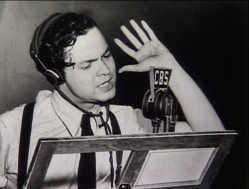
Invasion from Mars, 1938
Posted Monday, November 30, 2015, at 8:02 AM1From the archives of Paul Corbin It was 7 p.m. on Oct. 30, 1938. I was finishing a day's work on my Watkins delivery route in rural Stoddard County and had pulled my 1935 Ford car into Mr. Cazart's service station in Bloomfield. Mr. Cazart was filling my gas tank with six gallons of gas that would cost me one dollar... -
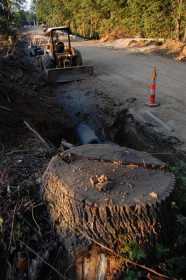
Capturing Oral History: Grandmother's trip over Bloomfield Road
Posted Sunday, October 25, 2015, at 9:25 AM3From the archives of Paul Corbin--2-17-2010 It seems that the Bloomfield Road which enters Cape Girardeau is a recurrent topic of conversation these days, since questions arise as to whether it should be widened and straightened to make it more convenient for traffic coming into town from the west--or whether it should be left as it is to preserve the scenic beauty of this historic road... -
My Short Term Memory
Posted Tuesday, August 25, 2015, at 8:58 AMFrom the archives of Paul Corbin Now that I am a senior citizen, I am finding that the citizenry as a whole is very considerate in tolerating the many deficiencies brought on by my declining years. Boys, young men, and beautiful ladies hold the door open for me as I enter the post office or the grocery store. ... -
Words we seldom use
Posted Friday, August 21, 2015, at 8:28 PMA never-before published story by the author I have never used the words in my vocabulary to write an obituary or an epilogue, but here I am at age 97, wondering if it would be appropriate and ethical to write my own eulogy. Webster defines the word "eulogy" as being an oration or written praise of accomplishments, but he didn't say who could be the writer, so I went to Mr. Google, and he said there was no reason why I should not write my own eulogy... -
What I learned in high school
Posted Tuesday, August 4, 2015, at 8:53 AMOriginally published in 2010 It has been 81 years since my first day in high school, and I still have the textbooks I used to guide me through that great adventure. We had to buy our own textbooks back then, and it sure took a lot of possum hides to pay my way through high school... -
Bottom of the Bucket
Posted Tuesday, June 30, 2015, at 9:34 AM1From the archives of Paul Corbin As I look back through the list of articles I have had published in various magazines during the past ten years, I find that I have written about my famous ancestors, my literate coon dog, my experience as a gold miner, how I became an archaeologist, how I cured my not-so-common cold, and 180 other fragments of my fickle mind... -

My Home Town--Part 3
Posted Wednesday, June 17, 2015, at 5:16 PMFirst-hand history of Advance In part two of the article "My Home Town," I mentioned that, back in the early 50's, the Inland Shoe Factory was growing just as fast as the town of Advance, MO could provide a building for John Lamarr to put his workers in. As I look back at the process of providing this space, I see it as being very much like a circus coming to town... -
My home town--Part 2
Posted Tuesday, June 16, 2015, at 6:31 AMEditor's note: This account was originally published on Nov. 11, 2009. Much has changed in the last six years, but Corbin's account remains as he wrote it. Back in 1839, a Mr. Joshua Mabery bought 80 acres of wilderness land that was located on a sand ridge practically surrounded by water. ... -
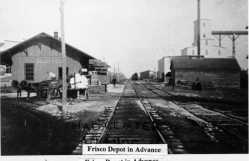
My home town--Part 1
Posted Thursday, June 4, 2015, at 1:04 PM1From the archives of Paul Corbin I was born and spent the first 18 years of my life on a 50-acre farm about six miles west of Advance; however, I have been living in town for over 66 years, so I think I should be eligible to claim this place as "my home town."... -
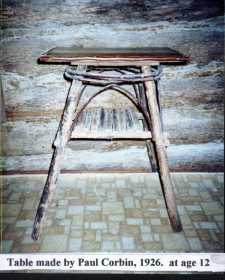
Before indoor plumbing--A Table for Mom
Posted Wednesday, May 6, 2015, at 10:31 AMFrom the archives of Paul Corbin It was back in 1926, but I can still remember the disgust in my mother's voice, as she said, "I wish we had a table to set the wash pan on!" As I reflect back on the situation, as it existed at the time, I can understand why she would make this statement... -
My sock darner
Posted Wednesday, March 25, 2015, at 7:23 AM2From the archives of Paul Corbin I never was very good at discarding or throwing away anything, so I was not really surprised when I was going through my sock drawer and discovered about 14 pairs of socks where one sock was in good condition and the other one had a hole in it. ... -

Trigger Madden
Posted Thursday, March 5, 2015, at 4:00 PM1From the archives of Paul Corbin I have often wondered if the few people who read the articles I write, sometimes get the idea that I am inclined to exaggerate, when I tell about my old hunting dog or my friends, Pappy Knight, and Podunk Pete. Now, I did graduate SUM-MA-CUMLAU-DE from my exaggeration class of '33, but when I write, I try to control the words I use and keep them on the straight and narrow. However, there may be a few times when I lose control of these words and let them wander... -
The Horse Trader
Posted Thursday, November 27, 2014, at 6:12 AM1In honor of Paul Corbin's 100th birthday TODAY, we are re-posting one of his more popular blog posts. This story was originally published on Dec. 30, 2007. By 1924, when I was 10 years old, Dad had upgraded his farm equipment to the point that he now owned a disk, which would cut a swath six feet wide every time he crossed the field, and it would cut about four inches deep. ... -
How I became an Archaeologist
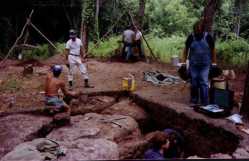
Posted Tuesday, July 9, 2013, at 3:50 PM3The word Archaeology is derived from the Greek word "Archaios," meaning ancient or old. Archaeology is a science devoted to the investigation, interpretation, and preservation of artifacts from an earlier life and culture, for the purpose of bringing to light the history, the customs and the life-style of a people, who in most cases left no written record of their existence... -
The Tornado of 1963: My memories
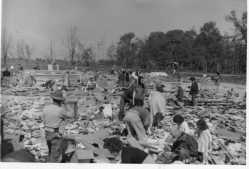
Posted Tuesday, June 25, 2013, at 10:27 AM4From the Past Back in 1943 I hired a small, two ton truck to hauled all my worldly possessions from Memphis, Tennessee and dump them in a small house at the corner of Grisham and Sturdivant St. in Advance, Missouri. That would make it 66 years that I have called Advance "My Home Town." When I came here, there were no paved streets, and there were still a few farmers coming to town in their horse-drawn wagons... -
The City Farmer
Posted Tuesday, February 26, 2013, at 4:20 PM2Rufus Quagmire was in a state of jubilation, as he closed the deal on a 200 acre farm, which was located at a point where the foothills of the Ozarks drops off to the flat lands in the south end of Bollinger County Missouri. About 40 acres of this farm was a timber-covered hill and the other 160 acres was good, flat, tillable land... -
The Moon Shiner
Posted Friday, December 28, 2012, at 7:41 PM2During the 1920's and up until 1933, the "moon shiner," the "bootlegger," the "rum runner" and the "speak easy" were making more money than anyone else in our part of the country. This all started on January 16, 1920, when the 18th Amendment made it illegal for anyone to make whisky or beer... -
Learning Arithmetic
Posted Friday, December 21, 2012, at 1:51 PM4Looking back at my early school days, I now realize that I was not what you would call an exceptionally bright student. Anyway, by the time I was 8 years old, I was in the second grade, and I could count to 100. Up until that time, I had to take my shoes off any time I wanted to count above 10... -
The Old Town of Greenbriar: Part 1
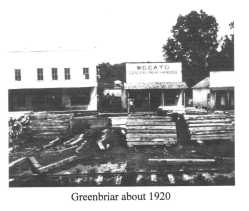
Posted Wednesday, November 14, 2012, at 6:48 AM1During the early 1920's, when I was growing up in South Bollinger County, Mo., our shopping center was the little town of Greenbriar. The story of Greenbriar has been handed down from one generation to another. It is reported to have gotten its name from the rambling wild rose that grew so profusely in the area. The roses are all gone now, and so is the town of Greenbriar... -
Going to school in 1920
Posted Wednesday, October 31, 2012, at 1:33 PM2I did not have to walk very far, when I started school back in 1920. The Stepp School, where I attended, was just across the Cato Slough, about 300 yards from where I lived in south Bollinger County. This school was the typical one-room building, about 20 feet wide and 40 feet long, with two rows of desks down either side and a wide isle down the middle. The girls were seated on one side of the isle and the boys on the other...
View all blog posts (49)