 Menu
Menu

- Email link
- Read comments (6)
- Share:


"The Thing"
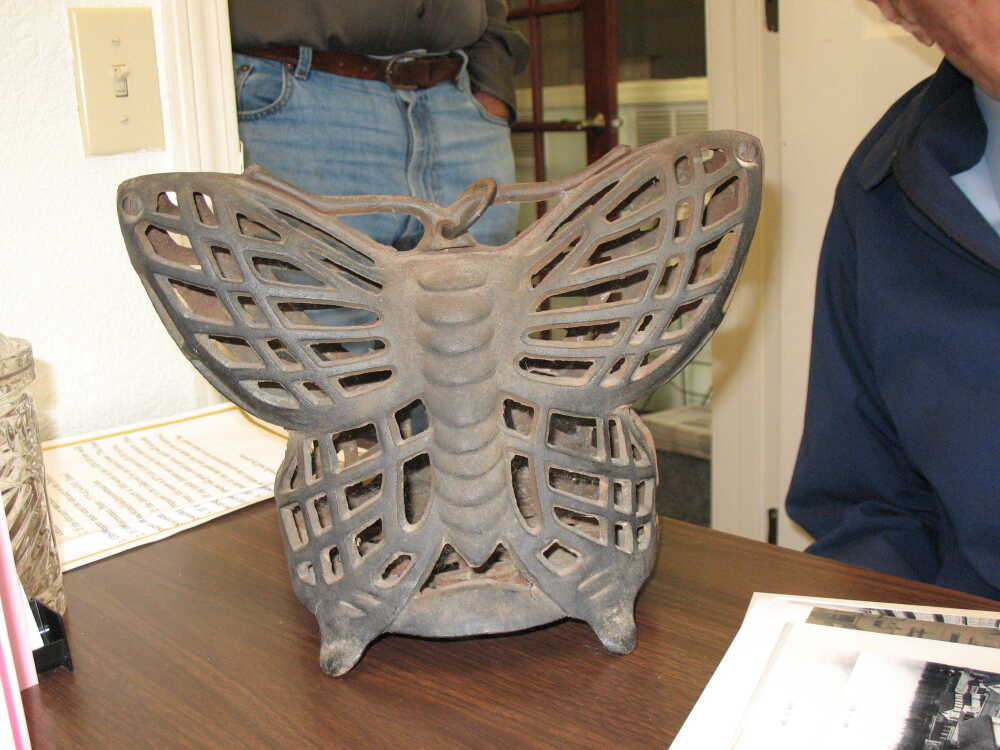
One day last week I stopped by the N.S.C. newspaper office in Advance, where Madeline Dejournett and I were having a rational discussion regarding the world economy, healthcare reform, taxes, and "Who owns the Grave Yard." We were well aware of the fact that these were important subjects that needed to be part of the "changes you can believe in," but at this time we were concentrating our effort in gathering more pictures and material for our book on the history of Advance, which we propose to write. We were moving right along and everything was going just fine, when we were interrupted by the shadow of Leon Wilton, as he walked through the door with a mystifying look on his face.
You might remember Leon. He is the guy who interrupted the monotony of our daily grind about a year ago, by bringing in a couple quart fruit jars that had screw caps on each end of the jars. We posted blogs, with pictures of these jars, and we published an article about them in the N.S.C. We had no idea as to why these jars had screw caps on both ends, so we asked people to give us their opinions as to what a fruit jar with a cap on each end could have been made for.
I have been writing articles for the N.S.C. and a few other magazines for about ten years, and it is not unusual that I get an e-mail or telephone call regarding some of these articles, but this one about the fruit jars went wild. I received 32 comments in one day from people all over the country, expressing their opinion regarding the purpose of these jars, none of which seemed to be a logical answer to our question, until I received an e-mail from a fellow in Colorado.
On this latest trip to the newspaper office, Leon didn't have anything in his hands or up his sleeve, but he did have a mischievous grin on his face, as he said, "I have something I want to show you." We immediately asked him what he had, and he said, "It is a 'thing,' or at least that is what the auctioneer said it was when he held it up for sale."
At this point Leon brought in his "Thing" and set it on the desk. Madeline and I both agreed with him."Yep, it is a 'thing,' all right, but what kind of thing?" Two sides of this unpainted cast-iron was in the form of a butterfly, with a wingspan of 11-1/2 inches, yet it looked like a cross between a birdcage and a rattrap, as there was a 7-inch cavity between the two identical sides. There was also a 3-inch round opening in the bottom of this cage that was closed by a cast-iron disk that snapped in place, with a quarter turn of the disk. This "thing" didn't do anything. It didn't make any sound, and it didn't go anywhere; however, this heterogeneous conglomeration of cast-iron seemed to express a degree of abstract quality as it sat there, doing nothing.
The fact that there is an opening in the bottom of this contraption would indicate that it was intended to be more than just an ornament, and since it had never been alive, we could not use the carbon-dating process to determine its age. So, when was it made, who made it, and why?? If you think that this "Madame Butterfly" is more than just an ornament, feel free to express your opinion by e-mailing pcorbin94@att.net or call 573-722-3505. As a closing thought, I might suggest that you rummage through the junk pile in your attic, out in your garage, or even in the discarded trash out behind your workshop. If you come on to something you can't identify, be sure to call Leon Wilton. If he does not know what you have found, he will probably offer you a hunk of money for it.
- Email link
- Read comments (6)
- Share:
Comments
-
-- Posted by goat lady on Mon, Apr 26, 2010, at 7:10 AM
-
-- Posted by Dexterite1 on Mon, Apr 26, 2010, at 4:13 PM
-
-- Posted by goat lady on Mon, Apr 26, 2010, at 9:39 PM
-
-- Posted by Dexterite1 on Wed, Apr 28, 2010, at 9:33 AM
-
-- Posted by kkcaver47 on Wed, Apr 28, 2010, at 1:17 PM
-
-- Posted by farmwife2 on Wed, Apr 28, 2010, at 1:51 PM
Respond to this blog
Posting a comment requires free registration:
- If you already have an account, follow this link to login
- Otherwise, follow this link to register