 Menu
Menu

- Email link
- Read comments (5)
- Share:


Forgotten Facts of History
The event of World War 1 has been well documented by historians, but no one knows for sure just how many people were killed during this conflict. It has been estimated that, including the military, and civilians, over 15 million people lost their lives during this war, which ended in 1918. It has also been estimated that the influenza epidemic of 1918 claimed over 21 million lives, making it one of the deadliest natural disasters in the history of mankind.
In checking the records of World War 1, we find that this was the first time that all service men were required to take flu shots, and it was also known that this vaccine was being made from a mish-mash of putrid protein. So many soldiers were dying from the flu that it was common talk of the day that more soldiers were being killed by medical shots than were being killed by lead bullets.
Even though the flu epidemic had its beginning just as the soldiers were returning home, it was never determined whether they were responsible for spreading it to other parts of the world. Historians gave this phase of the tragic event little more space than Babe Ruth received when he hit another home-run.
During the nearly 100 years that the Titanic has lain buried beneath the cold water of the Atlantic Ocean, it has become a legend, creating the basis of many novels, songs, movies, and stories. Historians tell us that the Titanic was the largest boat of its time and was touted as being unsinkable; however, on April 14, 1912 this luxury liner was traveling at about twenty knots through the icy waters off the coast of Newfoundland, when it struck an iceberg and sank, taking 1573 passengers and crew to a watery grave.
As tragic as this incident of the Titanic may seem, it was not the greatest boat accident in maritime history. The greatest loss of life in any one boating accident happened just a short distance from our own back yard.
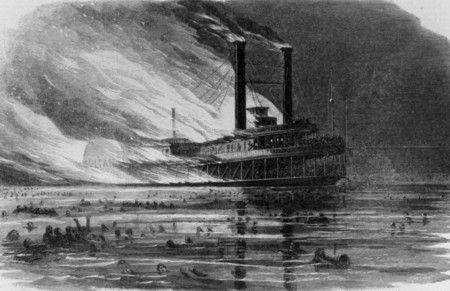
The "Sultana," a wooden side-wheeler steam-boat was designed to carry about 300 passengers, in addition to a regular cargo of farm products, including livestock, as it plied the Mississippi River on regular runs from New Orleans to St. Louis.
On April 26, 1865 the Sultana left New Orleans on what looked like a regular run to St. Louis; fully loaded with regular cargo and about 100 passengers. When she stopped at Vicksburg, Mississippi to take on more passengers, she was overwhelmed by a stampede of Union soldiers, who had just been released from Confederate prisoner of war camps. These soldiers were so anxious to get back home that they came on board faster than they could be registered, but it was estimated that 1800 to 2000 of them came on board the ship.
It was on April 27, 1865 that the Sultana was fighting the current of the muddy Mississippi, which was at flood stage, and out of banks for miles. The steam boat was about four miles north of Memphis, Tennessee, when one of the four boilers exploded, sending an orange-colored flame into the night-time sky and scattering burning coal, which immediately turned the superstructure into a burning inferno. Passengers not killed by the explosion or trapped by the burning wreckage were forced to jump into the swirling cold water of the dark Mississippi River, where about 1,700 passengers lost their lives.
The sinking of the Sultana seems to have been a well-kept secret, as this all happened just 18 days after the ending of our Civil War and just 12 days after the assassination of President Abraham Lincoln. These incidents were grabbing the headlines. Very few people, including some of our schoolteachers, have ever heard or read any account of this tragic accident.
- Email link
- Read comments (5)
- Share:
Comments
-
-- Posted by Madeline1 on Sat, Dec 10, 2011, at 4:56 PM
-
-- Posted by TNMom2 on Mon, Dec 12, 2011, at 10:43 PM
-
-- Posted by FJGuy on Wed, Dec 14, 2011, at 3:40 PM
-
-- Posted by goat lady on Sat, Dec 17, 2011, at 5:58 AM
-
-- Posted by Dexterite1 on Sat, Dec 17, 2011, at 6:25 AM
Respond to this blog
Posting a comment requires free registration:
- If you already have an account, follow this link to login
- Otherwise, follow this link to register