
[Nameplate] Partly Cloudy ~ 75°F  
High: 86°F ~ Low: 66°F
Tuesday, June 18, 2013

How I became an Archaeologist

Posted Wednesday, August 13, 2008, at 5:02 PM

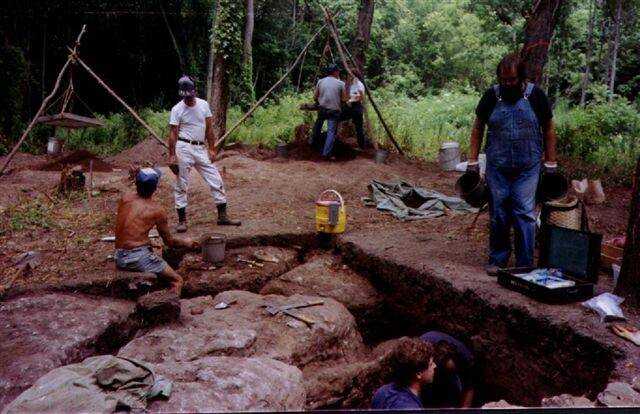
(Photo)
The Olive Branch site in Thebes, Illinois.
The word Archaeology is derived from the Greek word "Archaios," meaning ancient or old. Archaeology is a science devoted to the investigation, interpretation, and preservation of artifacts from an earlier life and culture, for the purpose of bringing to light the history, the customs and the life-style of a people, who in most cases left no written record of their existence.

Archaeology is not an exact science; however, it is an art that beckons the archaeologist: "Come discover the many secrets buried beneath our feet." It is a fascinating procedure, but should not be regarded as a treasure hunt, and should be performed in a systematic and professional manner.

We are all travelers in time, and the landscape around us whispers to the attentive mind the history of those who passed this way before us. Through careful study of artifacts and any items, with which these artifacts may be associated, and through the use of carbon dating, the archaeologist can reveal a fairly accurate picture of the history, the customs and the life-style of the people who created these artifacts.

Here on the North American Continent, archaeology and the American Indian are closely associated. Prior to the coming of the Europeans, the Indians were the only people to have ever inhabited this country. The Indian had been here for over fifteen thousand years and left no record of his existence, other than what the archaeologist can decipher from the trail of stones and bones he left behind.

I became interested in the American Indian at an early age, having found my first arrowhead when I was about twelve years old. Over the years, I have had the privilege of working with many noted archaeologists in several different states and on some of the off-shore islands in the Gulf of Mexico. I have put together a collection of artifacts, which has attracted the attention of archaeologists from various parts of the United States. Writers of books on archaeology have come to view my collection, take pictures and get data for their books.

Part of this collection, having an appraised value of $25,361.00 has been donated to the Missouri Department Of Conservation and is on display in their Interpretation Center in North County Park at Cape Girardeau, Mo.

While I was putting this collection of Indian artifacts together, the people of our community began to know me as "the fellow who is always digging or looking for old stones or bones that some Indian had lost or had thrown away a thousand years ago." They also learned that I would prepare their income tax forms for them and accept Indian artifacts as my fee. For twenty-six years I prepared income tax forms for about 300 people in our community, helping them convince Uncle Sam that they were paying 100% of their taxes.

However, in 1970 I notified my clients that they would have to find someone else to help them cheat the I.R.S., as I was going to become an archaeologist. I didn't know exactly what I would have to do to become an archaeologist, and at that time I was not even sure as to what the word archaeology meant.

Anyway, I did have one educated friend who even used the letters B.S. after his name, and I figured that this friend with his B.S. could help me become an archaeologist,

My friend said that in order to qualify as an archaeologist, I would have to be very patient and careful in my work. He said that I would have to make lots of notes, draw lots of diagrams, and, above all, I should keep a record as to the exact location of each and every artifact I came across.

This friend knew that I couldn't even remember the location of my car when I parked it in the lot at the mall. He also knew that, come Easter I could hide my own eggs and have a ball trying to find them. However this friend said that he had a plan that was "Fool-Proof." I knew right then that this fool - proof plan was just what I needed.

This friend told me to go to the variety store and buy a bag of 100 marbles. He said that when I was digging and came across any artifact I should stop right then and there, carefully pick up the artifact, for measurement or a picture, and, so that I would not lose the location of the artifact, I should mark the exact spot by placing a marble in the place where the artifact was found. He said I would qualify as an amateur archaeologist when I had lost all my marbles.

"Wait just a darn minute," I told him. "I don't want to be just an amateur; I want to go first class." But he told me that in order to qualify as a professional I would need more than 100 marbles.

Anyway, I think I am now a qualified archaeologist, as I lost all my marbles a long time ago.


Comments
Showing comments in chronological order
[Show most recent comments first]

Very cool! I'm sure the daily work of archaelogy is much more demanding - and probably tedious - than the Indiana Jones movies would lead us to believe!

I know of one student - Jason Kennedy from Advance - who has gone into the field of archaelogy.

-- Posted by goat lady on Wed, Aug 13, 2008, at 6:24 PM

Paul, I know a man who was a successful businessman when in his mid-30s he apparently woke up one morning and felt like he had to go out and start digging for Indian artifacts. So after much study he determined where there were likely locations of Indian settlements and started to systematically dig on weekends for artifacts. He spent years of weekends on these digs and was successful in finding hundreds, maybe thousands of artifacts. He eventually turned over all his diagrams and notes about these sites to a university to continue searching for artifacts. So, as you and this other man illustrate, a person with a yen and oodles of patience can be a successful archeologist.

-- Posted by FJGuy on Wed, Aug 13, 2008, at 8:47 PM

Paul, there has just been info released about an archeological dig in the Sahara Desert that shows it was once a well-populated area of lakes and lush greenery. One news story is, http://www.latimes.com/news/nationworld/...

-- Posted by FJGuy on Fri, Aug 15, 2008, at 12:36 PM

Paul,

I've taken great notice of this article, for I think you have, perhaps inadvertently, solved a mystery. You see, I, too, have lost a bunch of my marbles. Now I think I know who found them! I'm glad they were put to good use! Should you find you no longer need them, please send them back. I sure could use them! :-D

-- Posted by JillJohnston on Fri, Aug 15, 2008, at 2:55 PM

FJGuy, - -I just finished reading the verry interesting article you refered to "Glimse of life in a Sahara Desert" I can relate to this article as I have been part of events similar to this one. I worked about two weeks every year for ten years on this very interesting and productive, Olive Branch site, and one day during our lunch break I was sitting on a five gallon bucket eating a cold sandwich and drinking a cup of coffee when I happened to notice a large boulder protruding about six inches above the ground, and another boulder about ten feet from the first one, and I nearly chocked on my sandwach when I immagined that there cold have, at one time been a cavaty between these boulders. We immediately marked off a two meter square between these two boulders, and started digging. We were finding no artifacts but we could see that the soil we were working in was darker than the surrounding soil, so we kept digging and screening; a dull and fruitless effort for three days. We wre now down to 64 inches below the surface when the monotony was broken as everyone excitedly gathered around to see a deposit of charcoal that had been brought to light.

Further exploration gave evidence that the center of this cavity between the two boulder had been a fire pit, and round this fire pit we found bone fragments and projectile points.

Carbon dating of the charcoal indicated that it had been burried there, Seven to Nine Thousand Years

-- Posted by paulcorbin on Fri, Aug 15, 2008, at 3:02 PM

Paul, your story shows how much of life has an element of coincidence -- if you been sitting on an uncomfortable rock instead of the five gallon bucket, or been engrossed eating a candy bar instead of the cold sandwich, or had a cold cola to drink instead of a cup of coffee -- you might not have noticed the protruding boulders.

It is hard for us to imagine, but there is no reason to think that thousands of years from now there will be little visible trace of modern civilization. There was a fascinating book published last year "The World without Us" by Alan Weisman. "Scientific American" magazine had an extended interview with Mr. Weisman in its June 2007 issue. Accompanying the interview were pictures showing how rapidly Manhattan's buildings and infrastructure would decay without humans to maintain them. Literally within days nature would begin reclaiming Manhattan, and it would soon revert to the forest it was before being settled by Europeans. The interview is on SA's website at, http://www.sciam.com/article.cfm?id=an-e...

The online interview doesn't have all the cool pictures of Manhattan's deterioration that were in the magazine, so you might try to track down a copy of the magazine.

-- Posted by FJGuy on Sat, Aug 16, 2008, at 4:17 PM

Several years ago, I somehow found a website with photos of modern ruins. It was extremely eerie, because a photographer had gone in and taken pictures of massive, once-important buildings which had been abandoned and left to decay. I haven't been able to find that site since.

It reminds me of the haunting short story by Stephen Vincent Benet "By the Waters of Babylon," one of my favorite short stories of all time.

-- Posted by goat lady on Sat, Aug 16, 2008, at 8:27 PM

GL, I was unfamiliar with "By the Waters of Babylon." I found and read it as this webpage, http://www.cds.caltech.edu/~shane/text/b...

It has a mood and pace similar to Ursula K. LeGuin's short story, "The Ones Who Walk Away From Omelas." Which can be read at, http://harelbarzilai.org/words/omelas.tx...

Benet's short story is much more hopeful about the outcome of humankind's self-destructiveness than Nevil Shute's book "On The Beach," which starred Gregory Peck and Ava Gardner in the movie version.

-- Posted by FJGuy on Sun, Aug 17, 2008, at 12:17 AM

I vaguely remember "On the Beach" as pretty depressing. I like the optimism of the last line in "By the Waters of Babylon."

I went to the link for "The Ones Who Walk Away from Omelas," and I notice a familiar phrase that was also used in Benet's story: "How is one to tell about joy? How describe the citizens of Omelas?" I wonder which of these two stories was written first? Benet's was published in 1937 or so, I think. His is much more effective than LeGuin's, which has too much author editorializing, I think. Still, the tone is very similar.

Thanks for the links, FJ! We learn something new every day!

-- Posted by goat lady on Sun, Aug 17, 2008, at 8:37 AM

GL, the stories were published at about the same time. Benet's story was first published in 1973, and LeGuin won the 1974 Hugo Award for her short story. "On the Beach" is a somber book (and movie) because it is about how human life on Earth ends because a mistakenly launched missile results in total nuclear war between the US and the USSR that creates fatal levels of radiation poisoning that encircles the globe.

Humans are either at the top, or the bottom of the animal world depending on how you look at things. There was a period of overlap between the existence of Humans and Neanderthals (who had larger brains than humans do today), and recent archeological discoveries suggest they were at the height of their civilization when they disappeared. Some commentators think the Neanderthals didn't just die out, but they may have been exterminated by the more numerous Humans. Nevil Shute simply wrote about a possible scenario in which Humans do to themselves what they have done to others -- sort of a karmic payback.

-- Posted by FJGuy on Sun, Aug 17, 2008, at 4:41 PM

Fascinating, FJ, but I was teaching "By the Waters of Babylon" long before that 1973 date. I remember it in a textbook in 1964. According to Wikipedia:

"By the Waters of Babylon" is a post-apocalyptic short story by Stephen Vincent Benét first published July 31, 1937, in The Saturday Evening Post as "The Place of the Gods".[1] It was republished in 1943 in The Pocket Book of Science Fiction,[2] and was adapted in 1971 into a one-act play by Brainerd Duffield.[3]

Are you familiar with Michael Crighton's "Eaters of the Dead"? (Have we talked about this before??) He developed a theory that the ancient creature Grendal, written about in "Beowulf" (the first "English" manuscript) was, in fact, one of an entire tribe of Neanderthals, clashing with Cro-Magnon man (who eventually won out, of course..).

I do so admire people who can think outside the box like that and come up with an original idea!

-- Posted by goat lady on Sun, Aug 17, 2008, at 5:55 PM

Hey I share your fascination, only mine is with historical arch. I have a degree in historic preservation with a minor in history. We did a lot of field work, and I truly do love digging for relics.

-- Posted by mobrigade on Mon, Aug 18, 2008, at 2:18 PM

Mobrigade:- I can understand your facination in "Digging for Relics". It is a procedure that beckons you to come back for more.

Most of my work has been on prehistorical sites, however I was part of a nineteen man crew that worked two weeks on "Custers Trail", where he ruffeled the feathers in Crazy Horse's war bonnet, and lost his wig in the process.

-- Posted by paulcorbin on Mon, Aug 18, 2008, at 4:23 PM

When I was in junior high school I read about the digs at Troy and was hooked. For the longest time I wanted to be an archaeologist. Alas.

Years ago I went on a tour of the Holy Land. Talk about historic. I didn't get to participate in a dig, but I did get to tour one with a small group and talk to the archaeologists. It's so fascinating.

There was another SF story I loved about alien archaeologists who visited Earth after people were all gone. They excavated for artifacts and found all sorts of mysterious objects. Among all the other items, they discovered a reel of a movie in a metal tin, took it back to their world and proudly announced that they had finally discovered what the inhabitants of this planet actually looked like. When they ran the film it was a Donald Duck cartoon.

-- Posted by Ducky on Wed, Aug 27, 2008, at 10:53 AM

Oh, that's priceless! Do you remember the Star Trek episode where Kirk and Spock found the planet that had been corrupted - and they were all gangsters? Someone from Earth had left a Mickey Spillane novel there.

-- Posted by goat lady on Wed, Aug 27, 2008, at 10:49 PM

Yes. As a matter of fact, I do remember that episode. It was funny. Saw it on re-runs not too long ago and it was still funny.

-- Posted by Ducky on Fri, Aug 29, 2008, at 5:12 PM

GL, FYI Mickey Spillane was Ayn Rand's favorite popular author. Spillane's character Mike Hammer was a PI, not a gangster, so I don't understand that episode of Star Trek.

Paul, I enjoyed your story of the possible history of the small orb you found. I also like that you respected its history enough to place it back where you found it, instead of just assuming the right to keep it. What happened to the posting about the orb?

-- Posted by FJGuy on Sat, Aug 30, 2008, at 1:58 PM

Well, I'll be switched!! That story is gone from the archives!! Paul, you didn't delete it, did you? It should still be there.

-- Posted by goat lady on Sun, Aug 31, 2008, at 8:31 AM


Respond to this blog

Posting a comment requires free registration. If you already have an account, enter your username and password below. Otherwise, click here to register.

Username:

Password:  (Forgot your password?)

Your comments:
Please be respectful of others and try to stay on topic.


Bunyan Tales
Paul Corbin
Recent posts
Archives
Blog RSS feed [Feed icon]
Comments RSS feed [Feed icon]
Login
Paul Corbin is a 98-year-old historian, humorist, and amateur archeologist from Advance, Mo. He grew up in the Greenbrier area west of Advance, where he attended Stepp School on the banks of Cato Slough and the Castor River, important waterways throughout his life. In an age when many area residents did not go to high school, the young Corbin made the decision to walk the five miles to Zalma, graduating in 1933. Throughout his life, he was an enterprising businessman, selling Watkins products from house to house throughout a large area - and later opening a variety store in Advance. He and his wife Geneva traveled throughout the United States, even following the route that the Lewis and Clark expedition traveled. His knowledge of Native American culture is extensive, and he has donated a sizeable collection of his artifacts to the Cape Girardeau Conservation Nature Center and the Bollinger County Museum of Natural History in Marble Hill. He submits articles to TBY, the North Stoddard Countian, the Ozark Mountaineer, and several other Missouri publications. He has also written two books - "Reflections in Missouri Mud," and "Fragments of my Feeble Mind."
Hot topics
The City Farmer
(2 ~ 6:11 AM, Feb 27)

The Moon Shiner
(2 ~ 7:10 AM, Dec 30)

Learning Arithmetic
(4 ~ 5:08 PM, Dec 28)

The Old Town of Greenbriar: Part 1
(1 ~ 7:23 AM, Nov 14)

Going to school in 1920
(1 ~ 2:04 PM, Nov 1)