 Menu
Menu

- Email link
- Read comments (13)
- Share:


Why Teams Fail
I believe in teams. I am not just talking about teams filled with athletes but also seeing business leadership as a team, the church as a team and even the family unit working together as a team.
Throughout my life I have had the privilege to work on many different types of teams. My earliest memory of being on a team was when I played baseball for the Twilight Optimist. I still have the trophy, even though the bat that the player was holding is bent and I have long since lost the name plate...but we won and I treasure that first experience of team.
Later in life I developed my team skills through the military. I understood how important it is was for each person to fulfill there role or the team's mission may suffer or even experience the loss of human life.
When I was discharged from the Army I went to work at McDonnell Douglas Aircraft in St. Louis. Over the next few years I was able to move into management and was promoted several times. We were taught the Japanese management style and how they had achieved unprecedented levels of success. Under the Japanese management style, the organization is one where all employees are regarded as members of a team and everyone's input is equally important. This was in direct opposition to the traditional American style of top-down management....where the prevailing philosophy is "I'm the boss and you do as I say" (which by-the-way is the poorest and least productive style of leadership).
When I became a pastor in 1986 that same "top-down" style of leadership was prevalent in most of our churches. However it was creating a lot of conflict becuase of the poor definition of roles. Some thought it was the biblical style of leadership and others saw leadership from more a shared or team concept.
I grew up in a home with a patriarchal leadership. Dad was the leader, what he said happened, and there was little room for argument or discussion. Mom's role was primarily to support him and his decisions. While I am sure they had their own private conversations about his decisions it didn't appear to be a team style of leadership. Today many families struggle because of differing views of leadership and roles in the home.
A few years ago when I was the Director of Congregational Ministries for the General Baptist denomination I had the privilege to hear Patrick Lencioni speak on "The Five Dysfunctions Of A Team". I had the opportunity to teach this to many churches and even some local businesses. What he had to say was profound and insightful to those who are in leadership at whatever level; from the home to government.
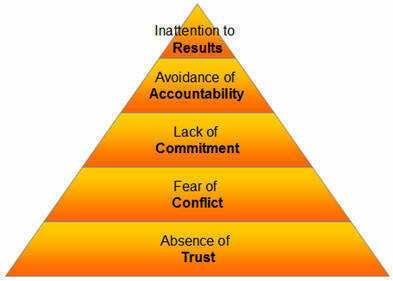
I will share the five dysfunctions and the write about how to overcome them in my next blog. If you are a leader or memeber of a leadership team please review the following honestly and examine the team you are leading. The five dysfunctions are as follows:
*Absence of Trust
*Fear of Conflict
*Lack of Commitment
*Avoidance of Accountability
*Inattention to Results
Dysfunction 1: Absence of trust. Members of teams with an absence of trust do the following:
*Conceal their weaknesses and mistakes from one another
*Hesitate to ask for help or provide constructive feedback
*Jump to conclusions about the intentions and attitudes of others
*Hold grudges
*Dread meetings and find reasons to avoid spending time together
*The symptom is the fear being vulnerable
Dysfunction 2: Fear of conflict. Where there is a fear of conflict teams:
*Create environments where back-channel politics and personal attacks thrive
*Ignore controversial topics
*Waste time and energy with political posturing and blame-shifting
*The symptom is artificial harmony or community
Dysfunction 3: Lack of Commitment. A team that fails to commit:
*Creates uncertainty among the team about direction and priorities
*Watches windows of opportunity close due to excessive analysis and unnecessary delays
*Breeds a lack of confidence and the fear of failure
*Revisits discussions and decisions again and again and yet fail to come a solution
*The symptom is ambiguity or uncertainty
Dysfunction 4: Avoidance of Accountability. A team that avoids accountability:
*Crates resentment among team members who have different standards of performance
*Encourages and sometimes even rewards mediocrity
*Misses deadlines and key goals
*Places an undue burden on the team leader as the sole source of discipline
*The symptom is low standards
Dysfunction 5: Inattention to results. A team that is not focused on results:
*Stagnates and ultimately fails to grow
*Rarely defeats competitors
*Loses achievement-oriented employees
*Encourages team members to focus on their own careers and individual goals
*Is easily distracted
*The symptom of this dysfunction becomes about status and ego
- Email link
- Read comments (13)
- Share:
Comments
-
-- Posted by BarbaraNTexas on Thu, Oct 15, 2009, at 12:39 PM
-
-- Posted by goat lady on Thu, Oct 15, 2009, at 1:50 PM
-
-- Posted by mrsdolphin on Thu, Oct 15, 2009, at 2:14 PM
-
-- Posted by BarbaraNTexas on Thu, Oct 15, 2009, at 2:32 PM
-
-- Posted by goat lady on Thu, Oct 15, 2009, at 7:26 PM
-
-- Posted by FJGuy on Thu, Oct 15, 2009, at 8:52 PM
-
-- Posted by MOGAL on Thu, Oct 15, 2009, at 10:21 PM
-
-- Posted by BonScott on Fri, Oct 16, 2009, at 9:46 PM
-
-- Posted by goat lady on Sat, Oct 17, 2009, at 7:23 AM
-
-- Posted by BonScott on Sun, Oct 18, 2009, at 1:48 PM
-
-- Posted by FJGuy on Mon, Oct 19, 2009, at 2:02 PM
-
-- Posted by BonScott on Mon, Oct 19, 2009, at 8:58 PM
-
-- Posted by BarbaraNTexas on Tue, Oct 20, 2009, at 7:17 AM
Respond to this blog
Posting a comment requires free registration:
- If you already have an account, follow this link to login
- Otherwise, follow this link to register